Active Herd Sires | Bos Sires
Red Angus

Murray Grey
BB Backbone’s General proudly holds the Forager stamp reflecting the pasture driven standards Backbone Ranch builds its program around. At Backbone, cattle are expected to thrive under forage based management in rugged, low input conditions where fertility, structural integrity, and grazing instinct determine long term value. General’s genetics are associated with cattle that make the most of available grass across varying environments, maintain body condition without heavy supplementation, and remain productive year after year.
He has been one of the most consistent and influential sires within the Backbone Ranch herd, reliably producing high quality bulls and heifers that mirror the ranch’s emphasis on balance and functionality. His daughters are recognized for strong maternal traits, well structured udders, dependable milk production, and the ability to maintain optimal condition under pressure. That maternal consistency reflects Backbone’s disciplined selection for cows that work within the limits of the land rather than depend on outside inputs.
Backbone Ranch has retained multiple sons of General as herd sires, further reinforcing his contribution to their breeding direction. His impact extends beyond the ranch, with progeny working across the United States and in Costa Rica. At ten years of age, General remains an active and valuable sire within the herd, embodying the longevity, durability, and forage efficiency Backbone Ranch prioritizes in building cattle for real world performance.

Murray Grey
Stamped with both the Forager and Bonsma Blueprint awards, BB Uncle Tony represents the instinctive grazing ability and functional, proven design rooted in Backbone Ranch’s practical, pasture first program. At Backbone Ranch, cattle are selected for doability fertility, structural integrity, temperament, and the ability to thrive under forage based management in the rugged conditions of central Queensland not for flashy numbers or input dependent performance.
His genetics are associated with cattle that move efficiently across large paddocks, maximize available forage in a variety of environments, and maintain condition with little to no supplementation. They reflect the qualities Backbone Ranch has long prioritized cattle that utilize pasture effectively, stay sound on feet and legs, and breed back consistently year after year.
Built on Jan Bonsma’s timeless principles of hormonal balance, structure, and true fertility, his masculinity and functional build were carefully evaluated and confirmed by the Bonsma All Breeds Group. Designed for real world performance rather than paper credentials, BB Uncle Tony stands as a genetic foundation that continues to strengthen herds with practical, resilient, low input functionality.

Beefmaster
Casey 0-61 carries both the Range King and Bonsma Blueprint stamps a pairing that reflects disciplined selection for endurance and biological function within the Casey Beefmasters program. At Casey, cattle are expected to prove themselves under practical ranch conditions where fertility, structural integrity, and fleshing ability determine long term value.
His genetics are associated with cattle that cover expansive pasture efficiently, convert forage into usable condition, and remain productive without reliance on heavy supplementation. Rather than being shaped by short term input driven performance, his type reflects moderation, balance, and adaptability suited for wide open, forage based systems.
Grounded in Jan Bonsma’s principles of hormonal balance, structural soundness, and reproductive efficiency and evaluated by the Bonsma All Breeds Group, Casey 0-61 represents low maintenance genetics designed for durability. For producers focused on sustainable performance and long term herd stability, he offers a foundation built on function rather than excess.

Beefmaster
Casey 5-145 proudly carries the Range King stamp reserved for cattle built to thrive in sparse, open environments and aligns with what Casey Beefmasters stands for. At Casey Beefmasters, cattle are selected for practicality, doability, and the ability to remain productive with minimal supplementation in real ranch conditions. Their program emphasizes fertility, structural soundness, and maternal strength that holds up under pressure rather than type alone.
His genetics are tied to cattle that travel for forage, maintain condition without heavy inputs, and conserve energy while staying productive across varied environments. That inherent efficiency reflects the Casey Beefmasters approach of breeding cattle that meet the demands of forage-based systems without dependence on high input strategies.
The Range King distinction isn’t just about toughness it marks cattle designed to work with the land not against it. For operations focused on sustainability, resilience, and independence from feed-heavy systems, Casey 5-145 offers the kind of durability and adaptability that supports herd strength and performance across generations.

Droughtmaster
Cashmere Leeroy carries both the Range King and Bonsma Blueprint endorsements a combination that reflects the disciplined, environment first philosophy behind Cashmere Cattle. At Cashmere, the goal is not extremes it is equilibrium cattle that balance capacity with efficiency, strength with mobility, and masculinity with fertility.
Leeroy’s genetics are tied to cattle that operate efficiently across large, open country without falling apart when inputs are removed. The focus is not just on surviving sparse rangeland, but on maintaining productive condition while doing so. That practical efficiency mirrors Cashmere’s belief that cattle must justify their place in the herd through performance, not appearance.
Meeting the hormonal balance, structural soundness, and efficiency standards set by the Bonsma All Breeds Group, Leeroy represents a selection process grounded in biological function. Masculine without being coarse and built with reproductive longevity in mind, he reflects the kind of steady, dependable genetics Cashmere Cattle prioritizes cattle designed to work within the realities of the land year after year.

Droughtmaster
Cashmere Madman carries both the Range King and Bonsma Blueprint endorsements a rare alignment that reflects disciplined selection under demanding conditions. Within the Cashmere program, cattle are not simply expected to endure harsh country they are expected to stay productive in it. The emphasis is on capacity, mobility, structural integrity, and reproductive efficiency that holds under pressure.
Madman’s genetic influence is tied to cattle that cover country with purpose, convert forage efficiently, and maintain functional body condition in wide, open environments. Rather than being shaped for accelerated gain or input dependent performance, his selection centers on balance, adaptability, and long term usefulness. He meets the hormonal balance, structural, and efficiency standards outlined by the Bonsma All Breeds Group reinforcing that functionality was never optional it was foundational.
Masculine in expression yet disciplined in design, Cashmere Madman represents a type built for rangeland realities cattle that work within the limits of the land and continue doing so across generations.
Madman as a calf with Dam

Droughtmaster
Cashmere Maverick carries both the Range King and Bonsma Blueprint endorsements a combination that reflects the long term, land driven priorities behind Cashmere Cattle. The program is built around cattle that are accountable to their environment first cattle that must hold condition, remain structurally correct, and stay reproductively sound without constant supplementation.
Maverick’s genetics are associated with cattle that handle expansive country with efficiency covering ground when necessary while maintaining functional muscle and body condition on forage alone. Rather than chasing size or short term performance spikes, his selection reflects Cashmere’s steady commitment to moderation, durability, and reproductive reliability.
By meeting the hormonal balance, structural, and efficiency standards set by the Bonsma All Breeds Group, Maverick represents genetics rooted in biological function. Masculine in presence yet controlled in type, and bred with fertility as a priority, he exemplifies the kind of resilient, practical cattle Cashmere Cattle is known for cattle designed to stay useful in real world grazing systems over time.

Droughtmaster
Cashmere Oakley carries both the Range King and Bonsma Blueprint endorsements a combination that reflects both real world durability and the philosophy behind Cashmere Cattle. At Cashmere, the focus is not simply on surviving tough country but on building cattle that convert harsh conditions into consistent performance. Their breeding program emphasizes moderate frame, true depth of body, strong feet and legs, and the kind of internal balance that supports fertility and longevity without heavy inputs.
Oakley’s genetics are known for the ability to travel, forage, and maintain condition on sparse rangeland mirroring that commitment to practicality. He was not selected for short term gain or artificial, input driven performance but for lasting functionality. Meeting the strict hormonal balance, structure, and efficiency standards set by the Bonsma All Breeds Group, he represents a disciplined approach to selection where fertility and structural correctness come first.
Masculine without excess and bred with long term herd productivity in mind, Cashmere Oakley stands as an example of the type of genetic consistency Cashmere Cattle strives for cattle that remain sound, fertile, and capable in demanding, low input environments.

Hereford
Texas-raised and heat-tolerant, Colombo III embodies the strength and resilience of our historic horned Hereford line, which traces back to the early 1900s in the rugged Chihuahuan Desert of Mexico. Originating in Coahuila, this herd was selected for adaptability, thriving in harsh conditions with minimal inputs. In the 1960s, the herd was closed to focus on superior internal selection, and about 20 years ago, a large group of heifers and top-choice bulls were hand-selected from the entire herd in Mexico by the late Gerald Fry, a well-known grass genetic expert. These cattle were brought to Texas, where careful breeding and selection refined the Colombo line of horned Herefords in Cameron, TX. Now located in Deep East Texas under Counter Culture Farms, Colombo III carries forward this legacy of hardy, old-school grass-based genetics. He represents generations of meticulous selection, proving his ability to thrive in diverse environments while maintaining the durability, efficiency, and quality that define our program.
Colombo III is both Zietsman Approved and a Graze Boss built for pressure and selected for purpose in a way that aligns with the philosophy behind Counter Culture Farms. At Counter Culture, cattle are expected to function in low input, forage based systems where fertility, structural integrity, and true adaptability determine long term success.
Handpicked by Johan Zietsman, he meets strict standards for hormonal balance, reproductive efficiency, and environmental fitness. His genetics are associated with cattle that maintain condition and continue breeding back in systems where high input, high maintenance cattle often struggle.
Bred to perform in ultra high density grazing environments, his type reflects resilience under pressure without sacrificing productivity. That kind of durability mirrors Counter Culture Farms’ commitment to building cattle that thrive on grass, support regenerative management, and remain profitable across changing seasons and c

Black Angus
DDA Alliance 142V comes from the Diamond D Angus program in Valier, Montana, where cattle are expected to perform under the demanding conditions of the Golden Triangle. With short growing seasons, limited rainfall, and long winters, only functional cattle last in this environment. For generations the DeBoo family has selected Angus cattle for fertility, structural soundness, longevity, and the ability to thrive on forage without excessive inputs.
Because of that disciplined selection pressure, DDA Alliance 142V carries both the Bonsma Blueprint and Zietsman Approved stamps. These designations recognize cattle that demonstrate the balance, hormonal functionality, structural correctness, and practical efficiency emphasized in the work of Jan Bonsma and Johan Zietsman.
Alliance 142V represents the kind of cattle that do not just look good on paper but continue to prove themselves where it matters most, in real world pasture conditions.
Dam of DDA Alliance 142V

Black Angus
DDA Fahren5Z represents the kind of functional Angus genetics that convert forage efficiently while maintaining the structural integrity and biological balance required for long-term productivity.
He was bred by Diamond D Angus in Valier, Montana, a program known for selecting cattle under the practical realities of the Golden Triangle. In an environment defined by limited rainfall, short growing seasons, and long winters, cattle must maintain themselves on forage and remain productive without excessive inputs.
Fahren5Z earned both the Forager stamp and the Bonsma Blueprint, designations that recognize cattle demonstrating the balance, structural correctness, and biological efficiency described in the work of Jan Bonsma. These marks reflect cattle capable of utilizing forage effectively while maintaining reproductive soundness and durability in real ranch conditions.
Though Fahren5Z has since passed, his genetics continue to carry forward the disciplined selection behind the Diamond D Angus program. The semen offered here represents the lasting influence of a bull bred for efficiency, balance, and longevity.

Mashona
“Double R 17” is a naturally polled, red carrier fullblood Mashona bull known for his exceptional calving ease, quiet temperament, and ability to thrive on poor-quality forage. His daughters are standouts for udder quality, foot structure, and fertility. Many achieving two calves by age three within a strict 45-day breeding season.
He brings impressive width for a Mashona and stands 54 inches at the hip, weighing in at 1650 lbs as a mature bull. Developed in a nonselective UHDG grazing system on fescue under high heat, humidity, and parasite pressure with no inputs or parasite control, “488” has proven himself as a rugged, low-maintenance sire. His easy-going disposition consistently passes to his progeny, making him a reliable foundation sire for regenerative and functional herds.
Angus X Mashona daughter from Double R 17 looks like. 5 years old, 4 calves 357 ICP.
SpeedGo back to previous menu
0.5x0.75xNormal1.25x1.5x1.75x2x
Exit fullscreenEnter fullscreen
Unable to load video. Try again later.

Mashona
Short. Slick. Thick.
Ferrari is the leading red Mashona bull at Counter Culture Farms, home to the largest Mashona herd in the United States. He was gestated, born, and raised under Ultra High Density Grazing in the hot, humid subtropics of Florida, where cattle are expected to perform on low quality tropical forages such as bahiagrass and bermudagrass without heavy inputs. Ferrari brings down frame size while adding tremendous gut capacity, the kind needed to maintain condition and keep working under intense grazing pressure. He has a calm disposition, an exceptionally smooth, oily slick hide, and produces offspring that show strong resistance to parasites and ticks.
Like most Mashona cattle, Ferrari consistently sires low birthweight calves. He is out of a proven 2+3 cow and carries forward the fertility, performance, hardiness, and nutritional adaptability Counter Culture Farms selects for. He does not fall apart when pushed hard on forage, even during the breeding season. Ferrari has earned both the Graze Boss and Bonsma Blueprint stamps, reflecting his fertility, structural balance, environmental adaptability, and ability to perform in a true low input system. Use Ferrari on cows that struggle to maintain condition or reproduce efficiently in forage based systems, and his offspring have the potential to change the direction of a herd in a single generation.

Hereford
A product of time tested maternal strength and real world selection
FINAN LEGACY traces back to a closed Hereford herd preserved since the 1950s. These genetics were shaped before industrial beef systems and maintained through disciplined, consistent selection. This maternal line was built on fertility, adaptability, and function, not trends or inputs.
His maternal foundation is proven by longevity under pasture only conditions, sustained reproductive performance, and the ability to remain sound and productive without intensive management. These cows were expected to breed, raise calves, and maintain condition on forage year after year.
He was selected on pasture, where balance, efficiency, and durability mattered more than size or appearance. He represents moderation with purpose, avoiding excess while maintaining the kind of structure and functionality that holds up over time.
This is a bull bred to last, rebreed, and adapt. He fits operations focused on fertile, long lasting daughters, cattle that maintain condition on grass, and low input beef systems built for resilience and longevity.
FINAN LEGACY reflects cattle bred for grass, time, and reproduction, not artificial environments or short production windows.

Aubrac
Fred Oliver holds both the Zietsman Approved and Graze Boss stamps reflecting disciplined selection for fertility, balance, and true grazing performance. Evaluated under Johan Zietsman’s standards for hormonal integrity, structural soundness, and reproductive efficiency, he represents cattle designed to function under pressure rather than depend on ideal conditions.
His genetics are associated with cattle that remain steady in demanding grazing systems where forage competition is high and management intensity is real. Rather than falling apart under stocking pressure, his type reflects internal efficiency and adaptability suited for ultra high density grazing environments.
Whether operating in tightly managed systems or broader pasture settings, Fred Oliver represents durable, pasture focused genetics built to stay fertile, efficient, and productive when the land carries the load.

Wagyu

Hereford
This bull carries both the Bonsma Blueprint and Forager stamps bred for balance and built for the land in a way that reflects the priorities of Meitler Cattle Company. At Meitler, cattle are selected with a focus on fertility, structural integrity, maternal strength, and the kind of quiet efficiency that holds up under practical ranch conditions. The goal is not extremes, but balanced cattle that stay sound and productive over time.
True to Jan Bonsma’s principles, he is structurally correct, hormonally balanced, and naturally fertile. His build reflects intentional selection rather than coincidence, and his type has been carefully evaluated and confirmed by the Bonsma All Breeds Group. That disciplined approach mirrors Meitler’s commitment to cattle that prove themselves through real performance rather than paper credentials.
On the land, his genetics are associated with cattle that utilize forage efficiently across varied environments and maintain condition with minimal supplementation. For operations seeking functional, low input cattle that contribute longevity and maternal consistency to the herd, he represents the kind of practical foundation Meitler Cattle Company stands behind.

Brahman
HM Hotshot 411 is one of the finest herd sires ever produced by Hayden Moore and is an outstanding representation of the Moore breeding philosophy. Raised from a program built around fertility, structural soundness, longevity, and grass efficiency, Hotshot combines exceptional breed character with the functional traits that made the Hayden Moore program internationally respected. Backed by generations of disciplined selection, he represents the kind of practical, profitable Brahman genetics that thrive in real-world commercial environments.

Brahman
487 is a very moderate, thick, easy fleshing bull. His Dam BK 181 is an ABBA Maternal Merit Cow and his full sister BK 250 is the most popular cow at Kempfer Cattle Co. He will sire well balanced productive daughters.

Brahman
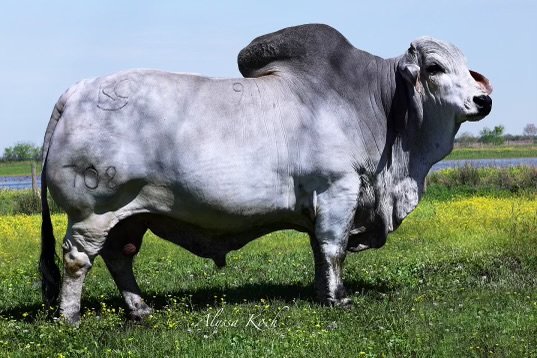
708 is an extremely moderate framed, easy fleshing bull. He sires calves with great dispositions. His daughters are proving to be very productive females with beautiful udders and small teats. His sons have demanded strong prices at the Kempfer Cattle Company bull sales, going to both purebred and commercial operations. He comes from a long line of extremely fertile cows.
Mashona

Brahman
Mr Kallion 1352 is one of the most widely used Brahman bulls in the American cattle industry. Both domestically and internationally, he has earned a reputation for consistently producing functional, docile, deep-bodied, easy-fleshing, and heavily boned offspring. He has become the go-to sire for many registered and commercial cattle operations seeking practical, low-input cattle that perform under real-world conditions.
Arguably, his greatest strength is his exceptional temperament. To date, approximately 99% of his calves have been scored as extremely docile, and even his least docile offspring would still be considered calmer than the average Brahman. His ability to consistently pass on disposition, along with fertility, structural soundness, and functionality, has made him one of the most influential sires in modern Brahman breeding.

Brahman
Mr Kallion Scooby 1973 is one of Kallion Farms' leading herd sires, used in both registered and commercial operations domestically and internationally. He combines exceptional power, depth of body, and a clean underline with the maternal strength of one of Kallion's most proven cow families. His offspring have quickly established themselves among the top calves produced at Kallion Farms, demonstrating the fertility, functionality, and performance the program is known for.

Hereford
A product of pre industrial genetics and real world fertility
MR FINAN represents authentic Hereford genetics preserved within a closed herd maintained since the 1950s. These cattle are developed with an intentional focus on function, fertility, and adaptability, rooted in genetics established before high grain feeding, confinement systems, and single trait industrial selection.
He is selected entirely under pasture based conditions, where hormonal balance, natural body condition on grass, and structural soundness are prioritized. He carries masculinity and presence without excessive frame or artificial growth, maintaining the kind of balance required for long term usefulness. This bull is not feedlot developed nor selected for short production windows. His value lies in real world functionality, including efficient cow coverage and durability under forage based conditions.
His maternal background reinforces this foundation. His dam reproduces under extensive management, demonstrating the practical fertility and adaptability required in low input systems. MR FINAN fits operations seeking genetics that thrive without grain dependency, bulls that work efficiently on pasture, and cattle rooted in pre industrial efficiency rather than modern excess. These genetics are meant to work with the land, not require the land to work for them.

Black Angus
NBA Deco 23K has earned the Forager stamp recognizing cattle with strong grazing instincts and forage efficiency the kind of functionality Nerbas Brothers builds their program around. At Nerbas Brothers, cattle are selected for doability in real ranch conditions fertility, structural integrity, maternal strength, and the ability to convert pasture into performance without reliance on heavy inputs.
Deco’s genetics are tied to cattle that make efficient use of available grass across a wide range of environments and maintain condition with minimal supplementation. That natural forage efficiency mirrors Nerbas Brothers’ focus on cattle that stay productive in large scale, low input systems where reproductive consistency and longevity matter most.
For producers dependent on the land rather than the feed truck, NBA Deco 23K brings the kind of built-in efficiency that lowers costs, supports resilience, and contributes to a sustainable, pasture-based herd foundation.

Black Angus
NBA Lenny carries both the Forager and Bonsma Blueprint stamps a powerful combination of instinct and intentional design that aligns with the practical, pasture focused philosophy of Nerbas Brothers. At Nerbas Brothers, cattle are selected for fertility, structural integrity, fleshing ability, and the kind of balanced performance that holds up under real ranch conditions in western Canada. Their program emphasizes cattle that function in large scale environments where longevity, sound feet and legs, and reproductive consistency are essential.
Lenny’s strong grazing drive and efficient forage utilization reflect those priorities. His genetics are associated with cattle that maintain condition across varied environments while requiring minimal supplementation to remain productive. That natural efficiency supports operations focused on profitability, environmental adaptability, and long term herd stability.
Backed by Jan Bonsma’s principles of hormonal balance, structural soundness, and fertility, his masculine build and functional design were carefully evaluated and confirmed by the Bonsma All Breeds Group. For producers seeking cattle that combine maternal strength, durability, and pasture based performance, NBA Lenny represents a foundation built for practical, real world success.
Calving Record of Lenny’s Dam
Lenny at 4 Months Old

Black Angus
OCC Kaden represents the kind of cattle Ohlde Cattle Company has spent decades developing: moderate framed, massively thick, extremely easy fleshing, and backed by generations of functional cattle. Tim Ohlde describes Kaden as a bull he has full confidence in using across a wide range of cattle, from Angus to cross-breeding programs.
His pedigree is backed by proven fertility and longevity on both sides. Kaden's dam has produced 10 natural calves by 13 years of age while also serving as one of OCC's top donor cows, and his sire is still naturally breeding cows at nine years of age in 2026.
Kaden is the first OCC-owned bull collected for international export in roughly 15 years, giving cattlemen around the world a rare opportunity to directly access Ohlde genetics.

Black Angus

Mashona

Aubrac
Post Oak Promo carries both the Range King and Zietsman Approved stamps built to travel further, last longer, and stay efficient on low input country. Recognized for meeting Johan Zietsman’s strict standards for fertility, adaptability, and real world functionality, he represents disciplined selection for cattle that must perform under environmental pressure rather than artificial support.
His genetics are associated with cattle that cover ground efficiently, utilize available forage fully, and maintain productive condition without reliance on heavy supplementation. That kind of internal efficiency reflects a program centered on fertility, structural soundness, and long term durability in wide open, forage limited environments.
Adapted to challenging range conditions, he remains reproductively consistent and practically efficient across seasons and terrain. For producers building herds designed to work with the land instead of against it, Post Oak Promo offers a balanced, resilient genetic foundation suited for sustainable, low input production systems.

Mashona

Black Angus
TQ Harvard carries both the Forager and Bonsma Blueprint stamps, recognition reserved for bulls that prove themselves where it matters most. Developed through the program at Totton Angus Ranch, where cattle are expected to perform on forage and remain productive under real ranch conditions, Harvard reflects the kind of disciplined selection that produces cattle built to work. He maintains condition on pasture and consistently passes that same forage efficiency to his offspring. Structurally correct and hormonally balanced, Harvard displays the masculine expression and internal function Jan Bonsma described as essential for long term fertility and adaptability. This photo was taken in the pasture after Harvard had already been running with 43 yearling heifers for over 30 days, a workload that reflects how he has always been used. As a yearling he bred 30 head in a tight window and every one calved unassisted. Linebred intentionally to proven cattle such as PAR Traveling Broadside 563 and Moderator P C 4034, each appearing six times in his pedigree, Harvard has stood out since a young age for his build, calm disposition, and ability to get the job done. Bulls like this do not make their mark in the show ring. They make it in the replacement pen, the calving pasture, and in herds that keep improving year after year.

Black Angus
TQ Masters Blend earned both the Forager and Bonsma Blueprint stamps for a reason. Raised through the program at Totton Angus Ranch, where cattle are expected to perform on grass and remain productive without excessive inputs, Master Blend embodied the kind of functionality Bos Sires stands behind. Though photographs of him are limited since his passing, his impact continues through more than 100 recorded daughters and over 425 birth weights logged with the American Angus Association, confirming his reliability as a calving ease sire built for practical ranch conditions. He held condition on forage alone and consistently passed that efficiency on to his offspring, proving that real-world performance begins with cattle built to utilize grass effectively. More than just a grass-efficient bull, Master Blend reflected the structural balance and internal efficiency described in Jan Bonsma’s work. Thick made, masculine, and naturally durable, he sired cattle that bred back, raised calves, and stayed productive in the herd.

Red Angus

Brahman
Rusty is a polled, exceptionally quiet bull and one of Tarramba’s leading sires for fertility. He combines moderate growth with exceptional fleshing ability and the capacity to maintain condition on forage.
Rusty is a son of Investor, Tarramba’s most influential sire, who has consistently produced easy-doing, highly fertile females with good udders. Rusty’s dam is a feminine, polled cow that has produced three calves at a 386-day average calving interval and is pregnant with her fourth, all under grass-based conditions. His granddam produced six calves at a 373-day average calving interval, while his full sister calved at two years of age and successfully rebred within a three-month joining period on grass.
Rusty is particularly noted for his quiet temperament, fleshing ability, large rumen capacity, and ability to efficiently utilize lower-quality forage.

Jersey
The Bear of Holt Creek is a homozygous polled, A2A2 Jersey bull developed in Holt Creek Jerseys’ 100% grass-fed, seasonal-calving program. His pedigree combines generations of Holt Creek maternal genetics with influences from North Coast, Netherhall Jerseys, Purely Pastured/Holterholm, and New Zealand Jersey genetics.
The strength of The Bear’s pedigree is his dam, Bernadette-PP, an EX-92% cow that has remained productive in Holt Creek’s forage-based system. At nine years of age, Bernadette has maintained a 363.6-day lifetime average calving interval and recently completed a lactation at 5.5% butterfat. She is described as an easy-keeping grazing cow with the width, body condition, and well-attached udder needed for longevity in a grass-based dairy. The Bear was also the first calf born in Holt Creek’s 2024 calving season, the result of Bernadette conceiving on her first service.
The Bear is A2A2 Beta Casein, BB Kappa Casein, BB Beta Lactoglobulin, and homozygous polled. Holt Creek is retaining and using him within its own herd specifically to produce more females patterned after his dam.

Tropical Black

South Poll
VLCC 200 reflects the kind of cattle Bent Tree Farms has spent years developing, cattle built for fertility, efficiency, and durability under real ranch conditions. He carries both the Zietsman Approved and Forager stamps, recognition given to bulls that demonstrate the hormonal balance, structural integrity, and forage efficiency needed to remain productive in practical ranch environments. Raised within the Bent Tree Farms program, where cattle are expected to thrive on grass and remain useful in the herd, VLCC 200 represents the kind of disciplined selection that prioritizes longevity and functionality over short term trends.
Balanced in his structure and steady in his disposition, VLCC 200 sires cattle that maintain condition on forage and stay productive year after year. The kind of cattle he leaves behind are built to breed back, raise calves, and remain durable in low input systems. Like the cattle Bent Tree Farms has become known for producing, his value is not measured in the show ring but in the pasture, where fertility, efficiency, and longevity ultimately determine whether cattle truly pay their way.

South Poll
VLCC 340 comes from the long-established program at Bent Tree Farms, where cattle are expected to prove themselves under practical ranch conditions. Carrying both the Bonsma Blueprint and Forager stamps, he reflects the kind of balance and efficiency those recognitions represent. The Bonsma Blueprint highlights cattle that demonstrate the internal efficiency and hormonal balance described by Dr. Jan Bonsma, while the Forager stamp recognizes animals that maintain condition and productivity on forage alone. Raised within the Bent Tree system, VLCC 340 is the result of breeding decisions aimed squarely at building cattle that last.
VLCC 340 sires cattle suited for real-world ranching, cattle that stay structurally sound, breed back consistently, and raise calves without needing constant inputs. His offspring show the kind of natural efficiency and calm temperament that make a cow herd easier to manage and more dependable over time. Like the cattle Bent Tree Farms has become known for producing, VLCC 340 proves his value in the pasture, where fertility, longevity, and forage efficiency ultimately determine the success of a breeding program.

South Poll
WDH 24 carries both the Forager and Bonsma Blueprint stamps, marks reserved for cattle that demonstrate the kind of efficiency and balance needed to work in real ranch conditions. Coming from the program at Bent Tree Farms, a ranch known for developing cattle that thrive on grass and require minimal inputs, WDH 24 reflects the philosophy that cattle should work for the land and the rancher, not the other way around. The program itself was built around producing animals capable of high fertility, longevity, and performance on forage alone, traits that remain central to the ranch today.
WDH 24 embodies that same approach. Structurally correct and hormonally balanced, he maintains condition on pasture and passes that natural efficiency on to his offspring. The kind of cattle he sires are built to stay productive in the herd, breed back consistently, and raise calves without excessive inputs. Like the cattle behind the Bent Tree program, his value is not measured in a show ring but in the pasture, where fertility, longevity, and real world adaptability determine whether cattle truly pay their way.

Black Angus
WT Newcastle Z241 left a strong mark on the Wedge Tent program. Deep bodied, thick hipped, and easy fleshing, he embodied the kind of real-world functionality this country demands. His daughters are the kind that stay in the herd, fertile, gentle, and built to last. The influence of Newcastle Z241 continues through his offspring, carrying forward his depth, soundness, and efficiency. Stamped Bonsma Blueprint and Forager, his genetics remain a reminder that true progress comes from cattle that endure, reproduce, and keep adding value year after year.

Black Angus
WT Newcastle Z241 left a strong mark on the Wedge Tent program. Deep bodied, thick hipped, and easy fleshing, he embodied the kind of real-world functionality this country demands. His daughters are the kind that stay in the herd, fertile, gentle, and built to last. The influence of Newcastle Z241 continues through his offspring, carrying forward his depth, soundness, and efficiency. Stamped Bonsma Blueprint and Forager, his genetics remain a reminder that true progress comes from cattle that endure, reproduce, and keep adding value year after year.

Mashona
